01.
Polarized
A filter built into the lens blocks horizontal glare bouncing off roads, water, and car hoods. The first choice for driving the GW Parkway, sailing the Chesapeake, or any sport on a reflective surface.
Polarized, photochromic, mirrored, gradient - paired with the designer frames we stock. We match the lens to the way you actually live and verify every pair before you walk out. One pair built for the sun, fitted to your face.

I stopped in to get my sunglasses adjusted and a really nice gentleman helped me. Great customer service - I will be back when my prescription needs renewing.

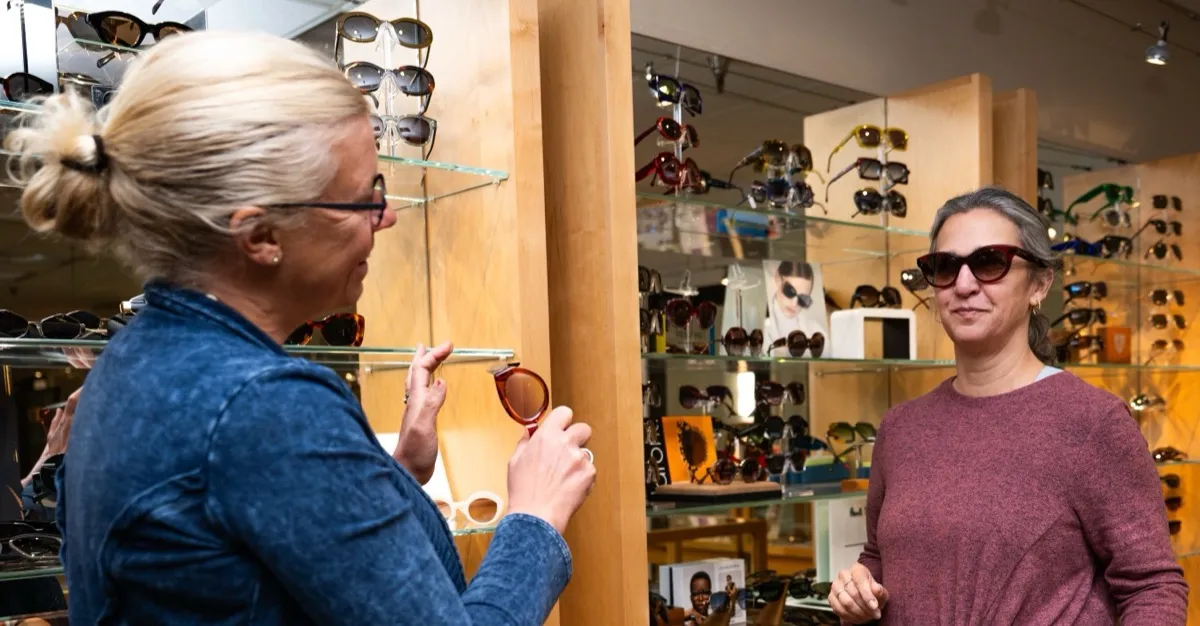
A great pair of prescription sunglasses is part lens engineering, part frame fit, part lifestyle match. All three have to come together, and that's the work we do.
Voorthuis opticians have fitted sunglasses for Washington-area families since 1973. We have met every prescription challenge a high-wrap sport frame can throw, most of them more than once.
Maui Jim, Tom Ford, Oliver Peoples, and more. Chosen for optical quality and frame durability, not formulary contracts. You see the full collection in person at our designer eyewear hub.
The right lens for a Beltway commuter is not the right lens for a weekend sailor. We ask how you spend your time outdoors before we pick a tint, polarization level, or frame wrap.
Every lens technology solves a different problem: glare, changing light, true color, or all-day comfort. Here is what each one is built for, so you can match it to how you spend your time outdoors.
A filter built into the lens blocks horizontal glare bouncing off roads, water, and car hoods. The first choice for driving the GW Parkway, sailing the Chesapeake, or any sport on a reflective surface.
Lenses that darken in sunlight and clear up indoors, one pair for a Metro commute and an afternoon in direct sun. The trade-off: most photochromics stay clear inside a car, where the windshield blocks the UV that triggers them.
A reflective layer on the lens exterior cuts the light reaching your eyes, useful for snow, open water, or bright altitude. Pairs well with polarization for the brightest conditions.
Darker at the top, lighter at the bottom, cutting overhead glare while keeping the dashboard, your phone, or a menu readable. A favorite on fashion-forward frames.
Applied to the back of the lens to stop the sun behind you bouncing into your eyes. Standard on our prescription sunglasses, where it does the quiet work most pairs skip.
Every pair blocks 100% of UVA and UVB up to 400 nanometers (the wavelengths linked to cataracts) baked into the lens material rather than applied as a coating that wears off. No upcharge.
The case for a dedicated pair (over clip-ons, fit-overs, or contacts with drugstore shades) and how to choose a lens that suits the light you actually live in.
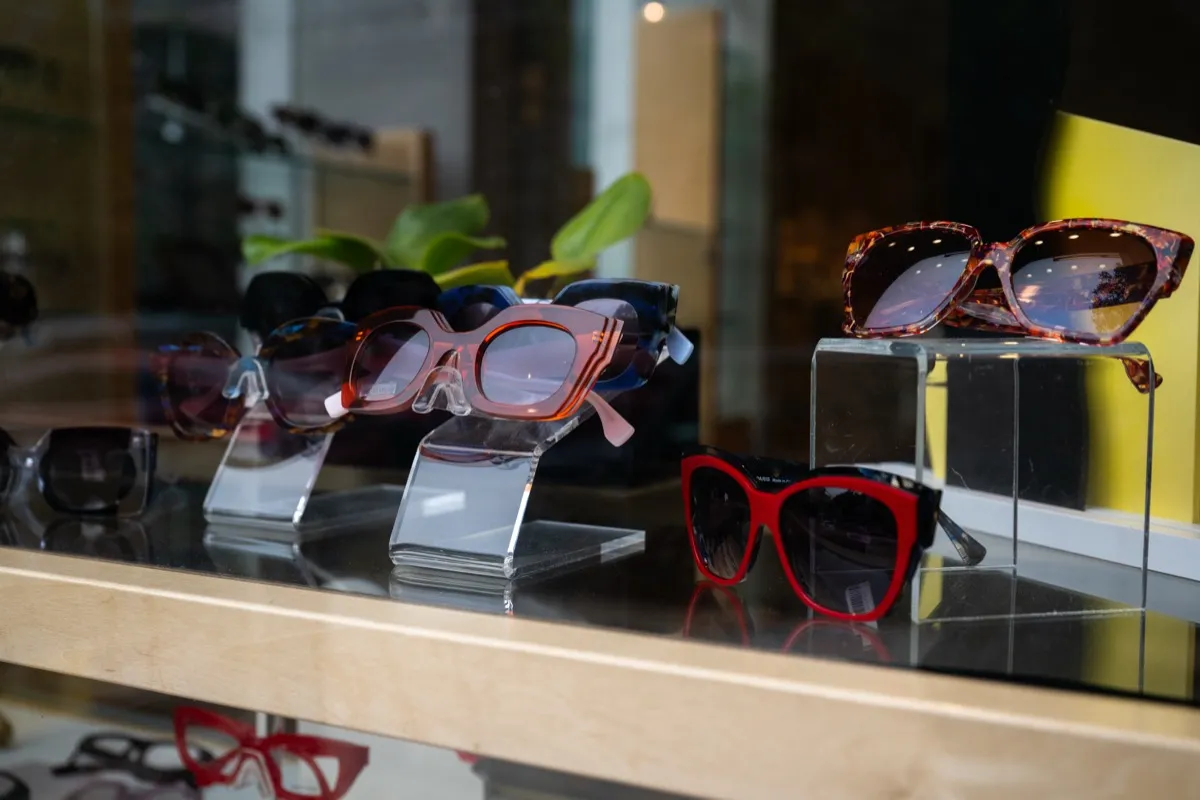
Clip-ons are easy to lose and can fall off during strenuous activity. Fit-overs leak light at the edges and limit which frames you can wear. Contacts plus drugstore shades leave you squinting at anything detailed. A pair built for your prescription holds clarity across the entire lens, gives you full peripheral vision, and sits comfortably because it was fitted to your face. You feel the difference the first afternoon you wear them.
Polarization is a filter that kills horizontal glare, the harsh, flat light that bounces off wet pavement on the GW Parkway, the surface of the Chesapeake, or the hood of the car ahead of you. If you drive, boat, golf, or fish, polarized lenses are the answer: they cut that glare and let you see into the water or down the fairway. The one trade-off is that some LCD screens (a few dashboards and phones) can dim at certain angles. For everyday city wear where glare is less of an issue, a quality non-polarized tint is fine.
Ultraviolet light does not take winters off, and up to 80% of it still reaches you through cloud cover. Cumulative UV exposure raises the long-term risk of cataracts (a clouding of the eye's lens) and macular degeneration. Every pair we fit blocks 100% of UV up to 400 nanometers, built into the lens material rather than applied as a coating that wears off.
For polarized performance, Maui Jim and its PolarizedPlus2 lens are where we point most patients first - it can be made in your prescription. Tom Ford and Oliver Peoples carry the same craft into frames that read dressier. Those are three of more than thirty designer houses on the wall - browse the full collection on our designer eyewear hub, then bring the frame back here for prescription sun lenses.
Some patients come in for one thing and discover they can solve everything in one place. At our Bradley Shopping Center store in Bethesda, one such patient left with prescription glasses for the office, prescription sunglasses for outdoors, and contacts for the weekends, all measured against a single, current prescription by the same team.
"Great experience here," he wrote afterward, "with prescription glasses, prescription sunglasses, and contacts. The full package - and super friendly staff."
G. · Bradley Shopping Center, Bethesda
| What matters | Prescription sunglasses | Photochromic everyday lenses |
|---|---|---|
| Best for | Driving, water, golf, bright sun | One pair for indoor/outdoor days |
| Glare off roads & water | Polarized, cuts it at the source | Darkens, but does not polarize |
| Behavior in the car | Stays dark, kills hood glare | Stays mostly clear (windshield blocks UV) |
| Indoors | Stays dark, it's a sun pair | Clears up automatically |
| How many pairs | A dedicated second pair | One pair covers most of the day |
For driving and time on the water, dedicated polarized prescription sunglasses win, because nothing else cuts glare the same way. If you want one pair that adapts from desk to sidewalk, photochromic lenses are the move; you can read more about them in our prescription lens guide. Many patients end up with both, on the same prescription.
What happens from the moment you walk in. We match the lens to how you spend your time outdoors, then verify every pair before pickup.
If your last exam was over twelve months ago, we start with a comprehensive eye exam with our on-site optometrist, including a sun-specific conversation about UV exposure and how you spend time outdoors.
Driving, sport, water, fashion, light sensitivity, frame preferences. Ten to fifteen minutes that shape every recommendation that follows. The right lens for a Beltway commuter differs from the one a weekend sailor needs.
Based on your face measurements, prescription, and style, we narrow the wall to a curated selection of frames you actually try on. An optician with years of experience helps you decide.
Polarized, photochromic, mirror, gradient, and tint colors compared side by side with sample lenses. We explain the trade-offs for your specific use so the choice is yours with full information.
Most pairs are ready in seven to ten business days. We inspect every lens against your prescription before pickup, adjust the frame to your face, and welcome you back any time for a free re-adjustment.
Voorthuis does not bill vision insurance, on purpose. That is what lets our opticians spend real time with you and recommend the right lens for your eyes, whatever a formulary covers.
Pricing comes down to three things: the frame brand and material, the lens design and treatments (polarization, photochromic, mirror, or a custom gradient), and your prescription strength (a strong Rx benefits from thin high-index material).
We provide a detailed itemized quote before you commit, broken down by frame, lens, and each coating. You see exactly what you are paying for.
We accept FSA and HSA and provide itemized invoices for out-of-network reimbursement.
The staff are knowledgeable, patient, and take the time to answer questions. My glasses were ready ahead of schedule, and I loved the selection of frames and sunglasses.Erika H. · Montgomery Mall
The service is outstanding and friendly, with an exceptional selection of prescription eyewear and sunglasses.David M. · Old Town Alexandria
Decent prices on sunglasses - I found a pair for $280 that I had seen at another store for $350.Rachel I. · Connecticut Avenue
Comprehensive, unhurried exams with an on-site optometrist - the time your eyes actually need.
Progressive, single vision, computer, and specialty lenses - measured, selected, and verified by an experienced optician.
Soft, hard, multifocal, and toric contact lens fittings. Trial lenses, insertion training, and follow-up included.
Maui Jim, Oliver Peoples, Robert Marc, Brunello Cucinelli and more - in clear, polarized, photochromic, and prescription.
Doctor-led tear-film evaluation, meibomian gland assessment, prescription therapy, IPL, and RF treatments - built around a real diagnosis.
Eyeglass repair, free lifetime adjustments on Voorthuis frames, screw and nose pad replacement, and ultrasonic cleaning - usually while you wait.
Call your nearest Voorthuis to choose prescription sunglasses with an on-site optometrist.