i.
Single vision
One prescription power across the lens. Right for distance-only driving glasses, dedicated readers, or younger patients with a single correction.
Progressive, single vision, computer, and specialty lenses sculpted and calibrated in our in-house labs. Measured, selected, and verified by an expert optician.
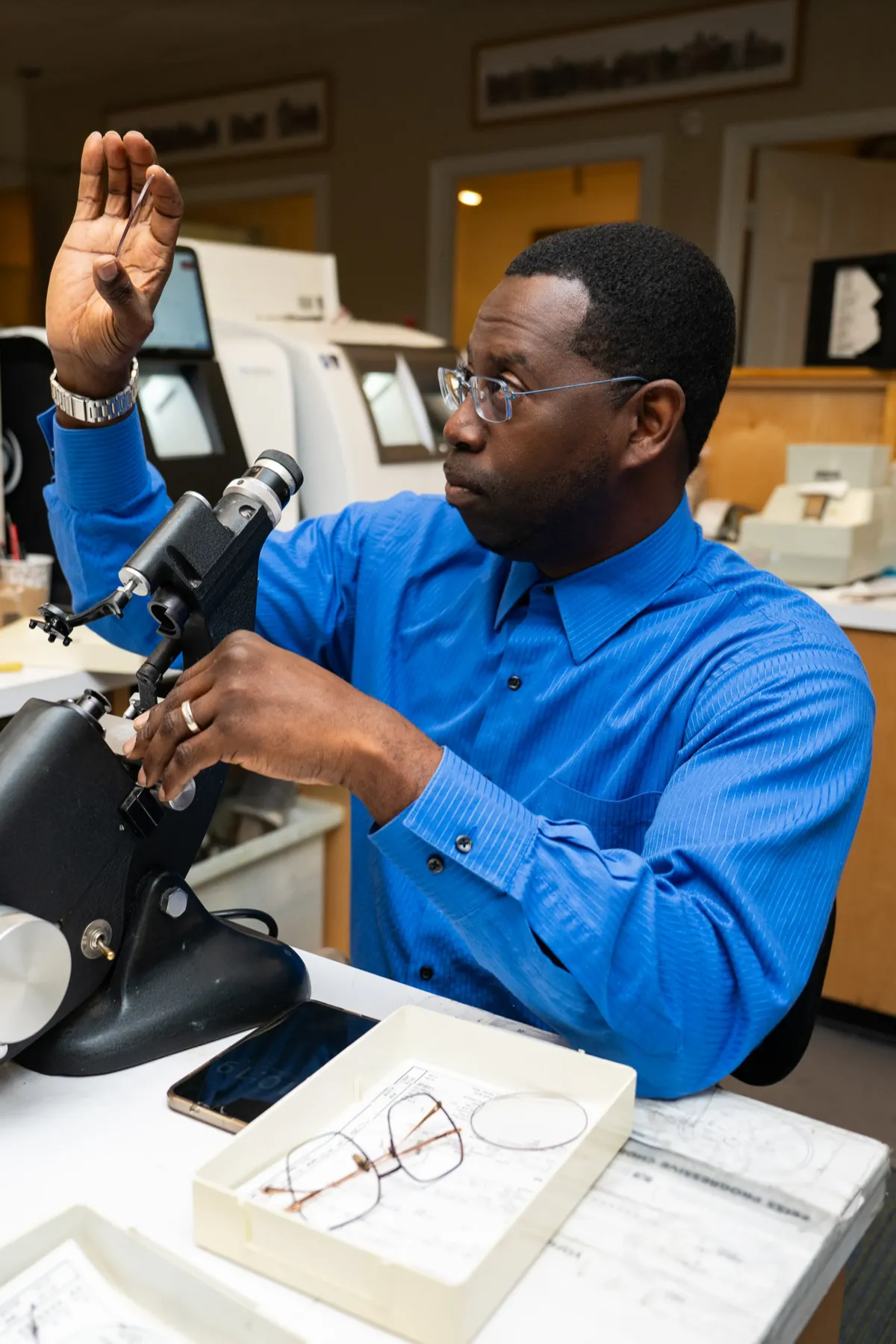

Buying lenses online or at a chain often means an auto-refractor measurement and a quick handoff. We do the harder work that turns a prescription into glasses you actually want to wear.
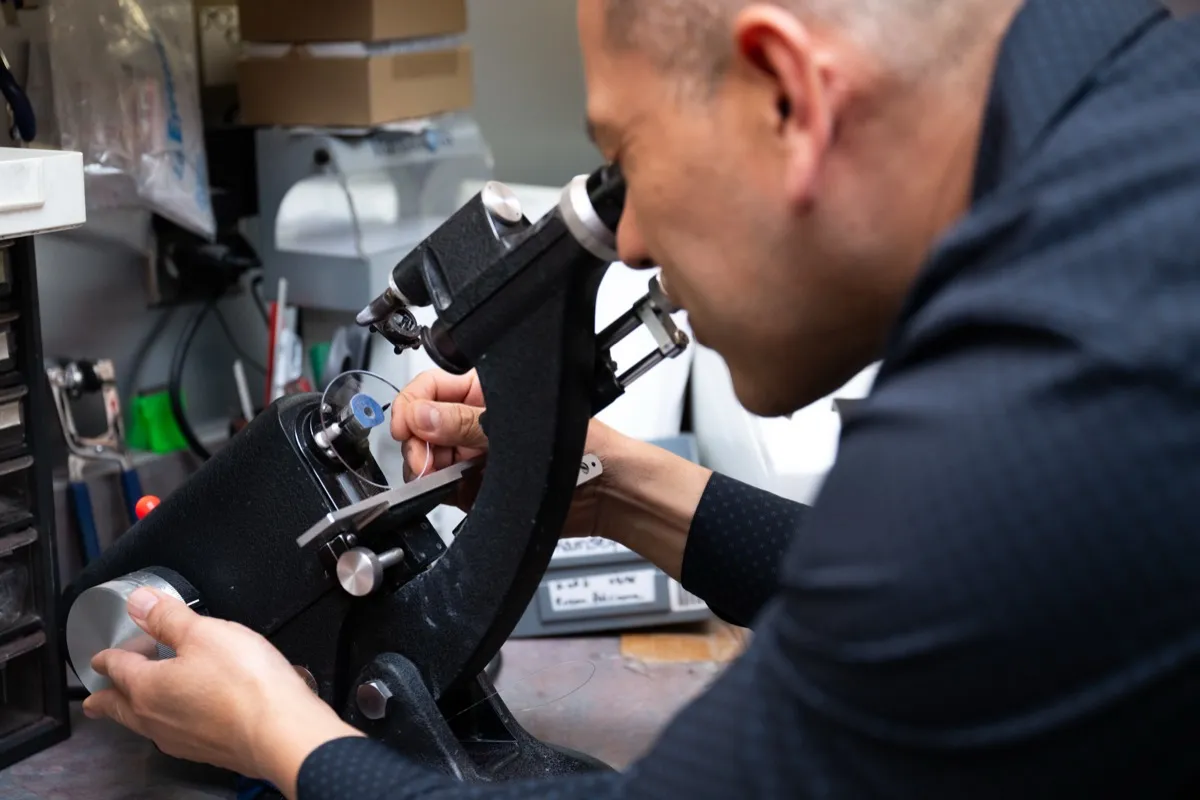
Pupillary distance (the gap between your pupils), fitting height, vertex distance (how far the lens sits from your eye), and pantoscopic tilt (its slight forward angle), each verified by hand.
Our opticians have been fitting lenses for Washington-area families for over a half-century. We catch fitting issues before they become comfort problems.
Your work setup, hobbies, driving habits, and screen time guide the recommendation. A trial lawyer reading briefs all day gets different lenses than a weekend cyclist.
Every set of eyes has different demands. Here is a breakdown of what we fit, with the work each type is built for.
One prescription power across the lens. Right for distance-only driving glasses, dedicated readers, or younger patients with a single correction.
Two distinct zones with a visible line. Practical when you want the widest possible reading area or prefer instant focus switching.
Near, far, and intermediate in one lens, with no visible line. The all-day choice once presbyopia sets in, usually after 40.
Optimized for 16 inches to 6 feet. Wider mid-range zones than standard progressives. A dedicated pair for the desk reduces neck strain.
Enhanced distance clarity with anti-reflective and polarized options for headlight glare and dashboard reflections, dawn, dusk, and night especially.
Polycarbonate or Trivex in wraparound or sport-specific frames. Built for racquet sports, cycling, and skiing, anywhere clarity and impact protection matter.
Lightweight, shatter-resistant polycarbonate with scratch-resistant and UV coatings standard. Built for active kids and short replacement cycles.
Single-vision lenses centered for your exact reading distance. They outperform drugstore readers because the prescription is built around your eyes, not an average.
Here is how progressives work, how to choose the right one, and the coatings that finish our lens.
A progressive lens corrects presbyopia (the age-related loss of up-close focus that begins for most people in their mid-40s) using a gradually changing prescription from top to bottom. You look through the upper portion for distance (driving, watching TV), the middle for intermediate tasks (computer screens, dashboard gauges), and the lower portion for reading and close work. The transition between zones is a smooth, gradual blend, which is why progressives are also called "no-line bifocals."
The trade-off: progressives have a narrower field of clear vision in the intermediate and reading zones than dedicated single-vision glasses, and the outer edges of the lens have some soft-focus distortion. That's a physics limitation of all progressive designs.
Your brain needs time to learn where to look through each part of the lens. A realistic timeline for most patients:
Whatever lens design you choose, the coatings decide how it performs in real light. What each treatment does, and who benefits most.
Anti-reflective (AR). AR coating eliminates distracting reflections from the lens surfaces, letting 99.5% of light pass through compared to 92% without it. The visual difference is immediate: sharper contrast, reduced glare from oncoming headlights, clearer screen work, and a cleaner look that lets people see your eyes through the lens. We recommend AR on virtually every pair. It is the single highest-impact upgrade available.
Blue-light filtering. Blue-light lenses reduce the amount of high-energy visible (HEV) blue light reaching your eyes from screens and artificial lighting. Current research from the American Academy of Ophthalmology shows no evidence that screen light damages eyes, but many of our patients report reduced visual fatigue during long work sessions. If you spend six or more hours a day on screens, it's worth trying, and we give an honest assessment of whether it's likely to help based on your specific symptoms.
Photochromic (Transitions). Photochromic lenses darken automatically in sunlight and clear up indoors, replacing the need for a separate pair of prescription sunglasses. Modern formulations (Transitions Gen 8 and XTRActive) activate faster and get darker than earlier versions. They don't darken inside a car, because the windshield blocks the UV that triggers the change, so consider polarized prescription sunglasses as a companion pair for driving.
Scratch-resistant coating. Applied to both front and back surfaces, scratch-resistant coatings extend lens life significantly. No coating makes lenses scratch-proof, but modern hard coats withstand daily wear from cleaning, pocket storage, and minor impacts far better than uncoated lenses. Included standard on most lens packages at Voorthuis.
UV protection. Prolonged UV exposure contributes to cataracts and macular degeneration over time. Polycarbonate and Trivex block 100% of UV inherently; CR-39 and high-index lenses need a UV coating applied. Every lens that leaves Voorthuis includes full UV protection - we don't charge extra for it.
Anti-fog coating. Reduces condensation when moving between temperature extremes: stepping outside in winter, opening a dishwasher, or wearing a face covering. Useful for healthcare workers, kitchen professionals, and anyone tired of wiping their lenses every few minutes.
Bradford came to our Old Town Alexandria store as an artist and photographer, someone, in his own words, "very sensitive about my vision." Trifocal progressive lenses are an unforgiving fit: get the corridor or the frame position even slightly wrong and the world never quite settles.
Our opticians worked through it together, the kind of team Bradford credited with "great expertise in vision correction." It was their hand-adjustment of the frames that, "allows me today to see perfectly with my trifocal progressive lenses." No small feat, he added, for eyes as particular as his.
Bradford left ready to send his closest friends our way - "to handle any or all vision needs."
Bradford S. · Old Town Alexandria
| Feature | Progressive | Bifocal |
|---|---|---|
| Vision zones | Distance + intermediate + near | Distance + near |
| Visible line | No | Yes |
| Computer vision | Built-in intermediate zone | No intermediate correction |
| Adaptation | A few days to two weeks | Minimal |
| Peripheral distortion | Some soft-focus at edges | None, but image jump at the line |
| Cost | Higher | Lower |
| Best for | All-day wear, screen work, active lifestyles | Readers who want the widest near zone |
Most of our patients over 40 choose progressives for the convenience of one pair that handles everything. Bifocals remain a valid choice if you want a wider reading zone or have tried progressives and found the adaptation difficult. Your optician will help you decide based on your prescription and habits.
The material your lenses are made from affects thickness, weight, durability, and optical clarity. The Abbe value below measures how cleanly a material bends light - a higher number means less color fringing at the edge of the lens.
| Material | Best for | Thickness | Impact resistance | Optical clarity |
|---|---|---|---|---|
| CR-39 · standard plastic | Low prescriptions, budget-conscious | Thickest | Moderate | Excellent (Abbe 58) |
| Polycarbonate | Kids, active lifestyles, safety | Thin | 10× standard plastic | Good (Abbe 30) |
| Trivex | Rimless frames, premium clarity | Thin | Comparable to polycarb | Very good (Abbe 43-45) |
| High-Index 1.67 | Moderate-to-strong prescriptions | Very thin | Lower | Good (Abbe 32) |
| High-Index 1.74 | Strong prescriptions, thinnest possible | Thinnest | Lower | Good (Abbe 33) |
Your optician factors prescription strength, frame style, and daily activities into the recommendation. A rimless titanium frame with a moderate prescription pairs beautifully with Trivex. A child playing soccer needs polycarbonate.
From the eye exam to the lab bench: the lens design, material, frame, and hand measurements that go into a pair built for how you actually see.
Our optometrist checks the front and back of the eye, looks at how your eyes work together, and screens for glaucoma, cataracts, macular degeneration, and the systemic conditions that first surface in the eye. This is the accurate prescription every lens is built on.
A conversation about how you actually use your eyes: work environment, hobbies, driving, reading, and any frustrations with your current lenses. The real customization begins here.
Your optician guides you through 30+ designer brands to find frames that complement your face shape, fit your prescription's height requirements, and match your style.
Pupillary distance (the gap between your pupils), fitting height, vertex distance (how far the lens sits from the eye), and pantoscopic tilt (the lens’s slight forward angle), all taken by hand. A millimeter off in fitting height means the reading zone lands in the wrong spot.
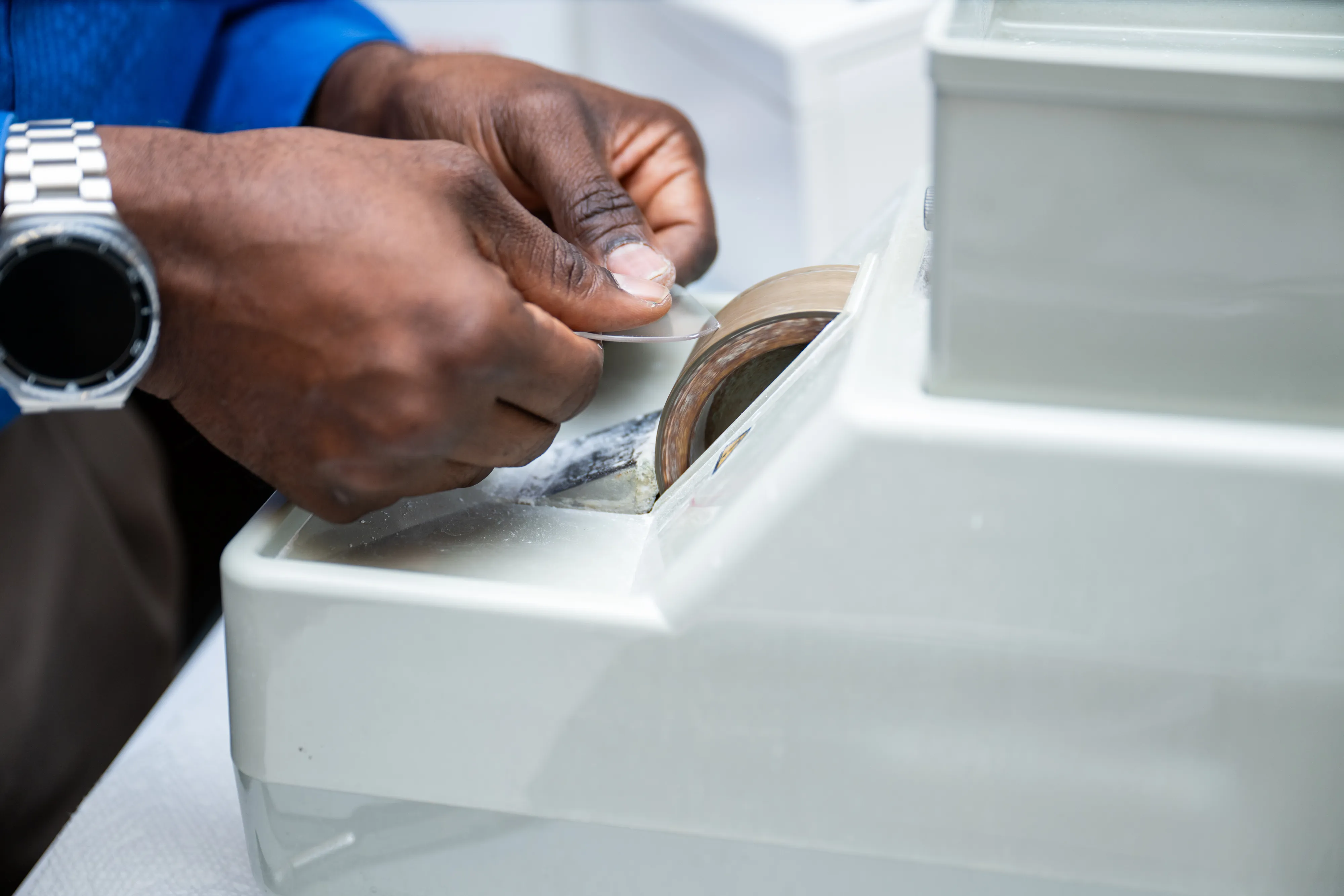
Lenses crafted in our own lab, inspected against your prescription before pickup. We dial in the fit at dispensing, call to check in after a week, and welcome you back any time for a free adjustment.
Voorthuis does not bill vision insurance panels, and we are direct about why. Those panels set short appointment windows and steer opticians toward a limited frame and lens list. Stepping outside them is exactly what lets us recommend what actually works best for your eyes and your day, whatever a plan happens to cover.
Lens pricing varies based on your prescription, material, lens design, and coatings. A general framework:
Start in a range comparable to high-quality independent opticians. Material upgrades (high-index, Trivex) and coatings add to the base price.
Cost more than single vision due to the surfacing technology required. Premium digital freeform progressives sit at the higher end.
Computer, sports, occupational, and driving lenses are priced based on the design and material selected.
We provide a detailed quote before you commit, broken down by lens type, material, and each coating so you see exactly what you're paying for, with no bundled add-ons and no surprise line items.
We accept FSA and HSA for your lenses, take all major credit cards, and provide a fully itemized medical invoice you can submit to your plan for out-of-network reimbursement. Many patients are reimbursed for a meaningful share of the cost.
I went in looking for lightweight frames, knowing they carried Silhouette. I’ve had them a few days and love them - the lightest frames I’ve ever felt, light lenses, and the best-cut lenses I have ever had. Very helpful and excellent quality of work.Jacob P. · Connecticut Avenue
I go here for my glasses and won’t go anywhere else. My prescription lenses always come back accurate, and the staff is friendly and knowledgeable when picking out frames. Perhaps more expensive than other stores, but well worth the value.Susan S. · Montgomery Mall
The entire team provided great care in lens and frame selection, and my glasses arrived in less than a week.Lorrie K. · Connecticut Avenue
Comprehensive, unhurried exams with an on-site optometrist - the time your eyes actually need.
Progressive, single vision, computer, and specialty lenses - measured, selected, and verified by an experienced optician.
Soft, hard, multifocal, and toric contact lens fittings. Trial lenses, insertion training, and follow-up included.
Maui Jim, Oliver Peoples, Robert Marc, Brunello Cucinelli and more - in clear, polarized, photochromic, and prescription.
Doctor-led tear-film evaluation, meibomian gland assessment, prescription therapy, IPL, and RF treatments - built around a real diagnosis.
Eyeglass repair, free lifetime adjustments on Voorthuis frames, screw and nose pad replacement, and ultrasonic cleaning - usually while you wait.
Call for an appointment.