Evaporative dry eye
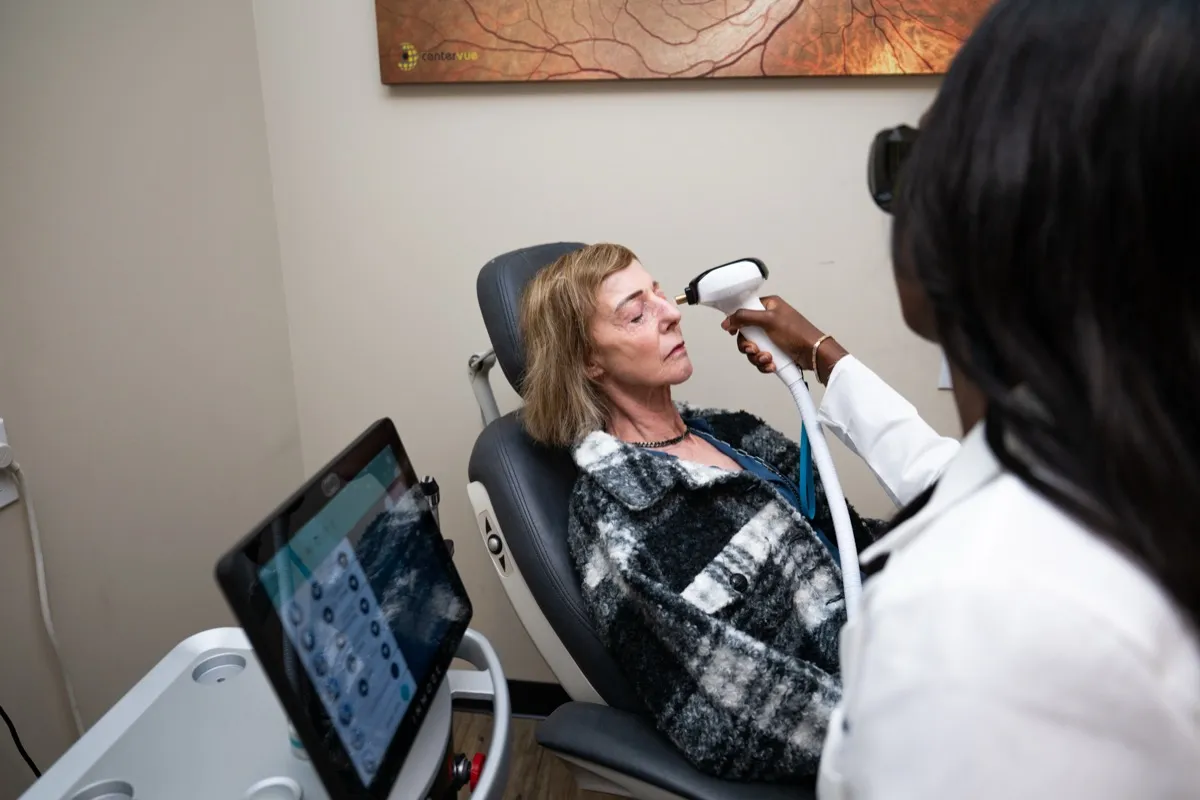
The oily top layer of the tear film is deficient, usually from meibomian gland dysfunction, so tears evaporate too fast. The most common pattern, treated with lid hygiene, warm compresses, omega-3, and in-office gland expression.
Doctor-led diagnosis and long-term management for dry eyes, eye fatigue, irritation, and digital eye strain. A real appointment to find causes such as tear-film quality, meibomian gland health, environment, medications.

I have a difficult eye condition and had seen a number of optometrists before. Dr. Robinson’s knowledge and attention to detail surpasses all of them by far.

Most dry eye visits end the same way: a free sample of artificial tears and a vague "use them four times a day." We treat dry eye as the medical condition it is, identifying the type, targeting the cause, and following the response over time.
Slit-lamp examination with staining, tear break-up time, and meibomian gland expression: the diagnostics that tell us whether your dry eye is evaporative, aqueous-deficient, or both.
Prescription anti-inflammatory therapy, IPL and RF treatments, environmental adjustments, specialty contact lens options, and lid-hygiene protocols, each chosen for your specific subtype.
Dry eye is chronic. We schedule follow-ups as needed to see what's working, adjust treatment, and catch progression early.
Your care is managed by a Doctor of Optometry with decades of combined experience treating dry eye disease across every stage and subtype.
It is a family of related ocular-surface problems, each with a different mechanism and a different treatment. The exam is what tells them apart.
The oily top layer of the tear film is deficient, usually from meibomian gland dysfunction, so tears evaporate too fast. The most common pattern, treated with lid hygiene, warm compresses, omega-3, and in-office gland expression.
The lacrimal gland makes too few tears to begin with. Treated with prescription anti-inflammatory therapy that calms inflammation so the gland can recover its own tear production.
Inflammation and blockage of the oil glands along the eyelid margin, the root cause behind most evaporative dry eye. Lid-hygiene protocols, warm compresses, and, where indicated, in-office RF (radio frequency) and IPL (intense pulsed light) to clear the blocked glands and steady the tear film.
Lid-margin inflammation, often with Demodex (a microscopic mite) involvement. Treated with targeted lid-cleansing and short-course topical therapy, the kind of cause a quick visit never looks for.
One of the most common reasons people abandon contacts. Resolved with a material change, a different replacement schedule, a change in solution, or the addition of a lubrication drop and a tailored wearing schedule.
Antihistamines, antidepressants, isotretinoin, and hormone therapy all dry the eyes; autoimmune conditions like Sjögren’s often surface here first. We identify contributors and coordinate with your other physicians to get you the care you need.
Dry eye is one of the most common and most misdiagnosed reasons people are uncomfortable all day. Here is what is happening on the surface of the eye, what drives it, and the point at which drops alone stop being the answer.

A healthy tear film is three layers working together: an oily outer layer that slows evaporation, a watery middle layer that nourishes the surface, and a mucous base that helps it all stick. Dry eye disease is what happens when that film fails, and it fails in two main ways. In evaporative dry eye, the oil layer is insufficient, usually because the meibomian glands (the oil glands along your eyelid margin) are blocked. In aqueous-deficient dry eye, the lacrimal gland simply makes too few tears. Many people have both, which is exactly why a single off-the-shelf drop so often disappoints.
The modern causes stack up. Long screen days cut your blink rate roughly in half, so the film dries between blinks. Tear production declines with age, and drops further around menopause. Common medications (antihistamines, antidepressants, isotretinoin, hormone therapy) reduce tears as a side effect. Autoimmune conditions can surface as dry eye first. Contact lenses, dry indoor heating, and DMV pollen all exacerbate tear film problems that lead to dry eye symptoms.
Artificial tears are a reasonable first step. But the symptoms often keep coming back after twenty minutes: burning, grittiness, redness by mid-afternoon, or blur that clears for a second when you blink. That is the signal the underlying cause is not being addressed.
A thorough evaluation with one of our on-site optometrists finds the subtype and matches treatment to it. Where dryness has made your lenses unwearable, we can refit you through a contact lens fitting. If you are overdue for a full check, a comprehensive eye exam can fold in the dry eye workup.
Alena came into our Old Town Alexandria store for what she thought was a slight eye infection. She had, in her words, been "to many eye doctors in the past, and no one had ever identified the actual problem." Dr. Figler performed a thorough examination, found the underlying issue, and gave her "an effective long-term plan for my extremely dry eyes."
What surprised her most was the standard of care from an independent optician. "Quite frankly," she wrote, "I did not expect this level of care." And the economics worked in her favor. As she put it, even without insurance for these visits, the cost was very reasonable, actually less than what she usually paid with insurance.
"It is truly a gem," she added. "I cannot recommend this place enough."
Alena M. · Old Town Alexandria
How a dry eye evaluation and treatment plan come together - from your first symptoms to a stable, comfortable ocular surface.
Burning, grittiness, blurry vision that clears with a blink, contact lens intolerance, redness by afternoon. Every symptom maps to a possible cause. We review medications, screen habits, and contact lens wear alongside them.
Tear break-up time, fluorescein and lissamine staining. These separate evaporative dry eye (the oily layer fails) from aqueous-deficient (the watery layer fails), and that distinction shapes everything that follows.
Slit-lamp examination of the lid margins, expression of the meibomian glands, and screening for blepharitis. The majority of dry eye has a gland component, so treating the lids is often the missing piece.
A tiered plan: environmental adjustments, lid hygiene, preservative-free artificial tears matched to your subtype, omega-3 where appropriate, prescription therapy (cyclosporine, lifitegrast, or a short corticosteroid course), and in-office IPL or RF treatment when the glands need more help.
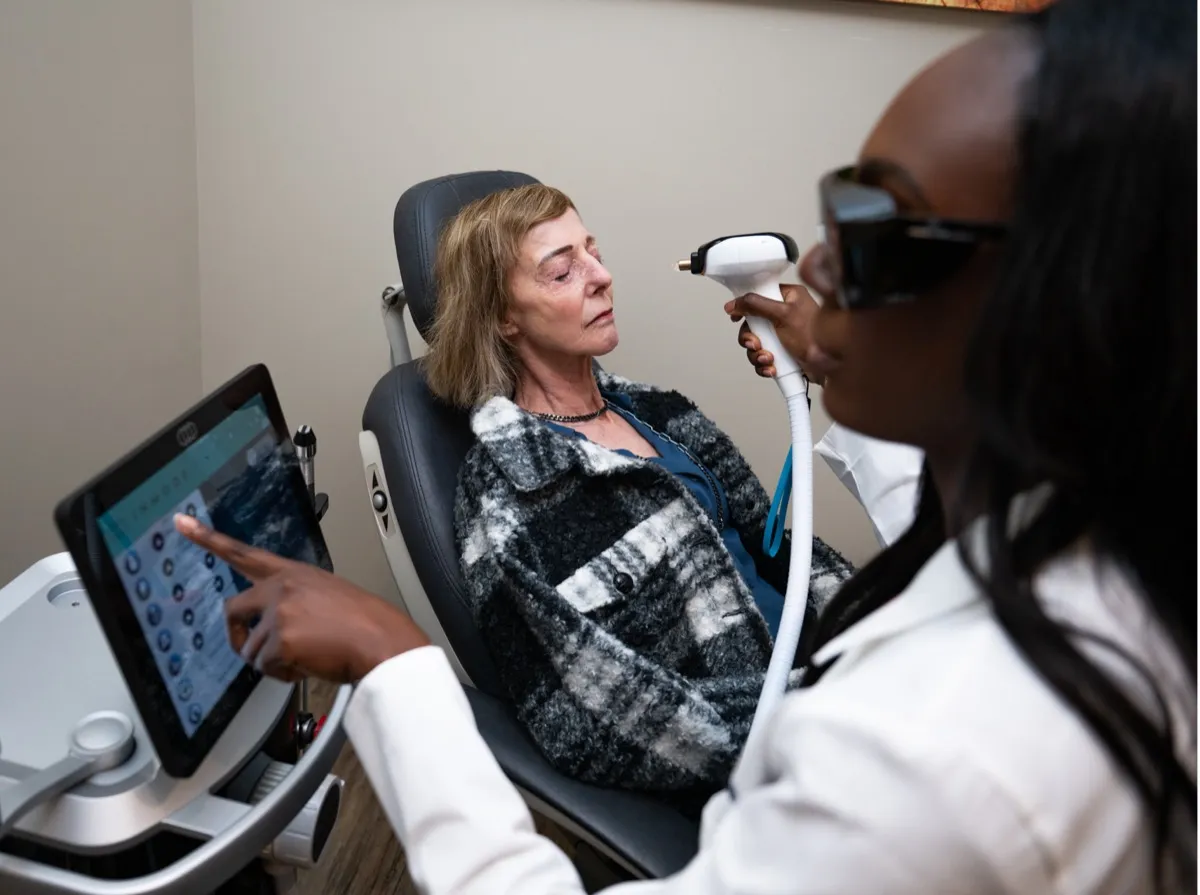
Follow-ups as needed to verify response and adjust therapy. When the glands need more than compresses, in-office RF (radio frequency) warms the lids to reopen them, and as a side benefit softens the fine lines and crow’s feet around the eyes. IPL (intense pulsed light) can further treat the lids when inflammation is an issue contributing to gland function. We adjust the plan as your symptoms settle.
A dry eye evaluation at Voorthuis is priced competitively, and the visit is built around a real diagnosis. Because we don't bill vision insurance, there are no surprise copays and no panel restrictions on which tests your doctor can order or which prescription drops your optometrist can recommend.
IPL, RF, and specialty contact lens fittings are priced separately by the job and discussed before you commit. Prescription drops are billed through your medical (not vision) insurance and filled at your usual pharmacy. Call any location for current pricing.
We accept FSA and HSA, take all major credit cards, and provide a fully itemized invoice you can submit to your plan for out-of-network reimbursement.
I saw Dr. Figler for a same-day appointment due to eye issues. The office got me in quickly, and the doctor was thorough and friendly - great care all around.Jessica A. · Old Town Alexandria
I have complicated myopia and have seen ophthalmologists and optometrists my whole life - I have never met anyone as detail-oriented as Dr. Udoff.Aparna M. · Foxhall Square
My spouse has Parkinson’s, and Dr. Voorthuis examined their eyes with compassion, competence, and thoroughness.Karen H. · Bradley
Comprehensive, unhurried exams with an on-site optometrist - the time your eyes actually need.
Progressive, single vision, computer, and specialty lenses - measured, selected, and verified by an experienced optician.
Soft, hard, multifocal, and toric contact lens fittings. Trial lenses, insertion training, and follow-up included.
Maui Jim, Oliver Peoples, Robert Marc, Brunello Cucinelli and more - in clear, polarized, photochromic, and prescription.
Doctor-led tear-film evaluation, meibomian gland assessment, prescription therapy, IPL, and RF treatments - built around a real diagnosis.
Eyeglass repair, free lifetime adjustments on Voorthuis frames, screw and nose pad replacement, and ultrasonic cleaning - usually while you wait.
Call your nearest Voorthuis to book a dry eye evaluation with an on-site Doctor of Optometry.