01.
Soft daily disposable
A fresh pair every morning, discarded each night. No cleaning, no case, lowest infection risk. The starting point we recommend for most first-time wearers and allergy sufferers.
The right contacts start with a comprehensive exam. Our in-house optometrists carefully check your prescription, tear film, and cornea, and match you to a lens that holds up through screen work, workouts, and DMV humidity.
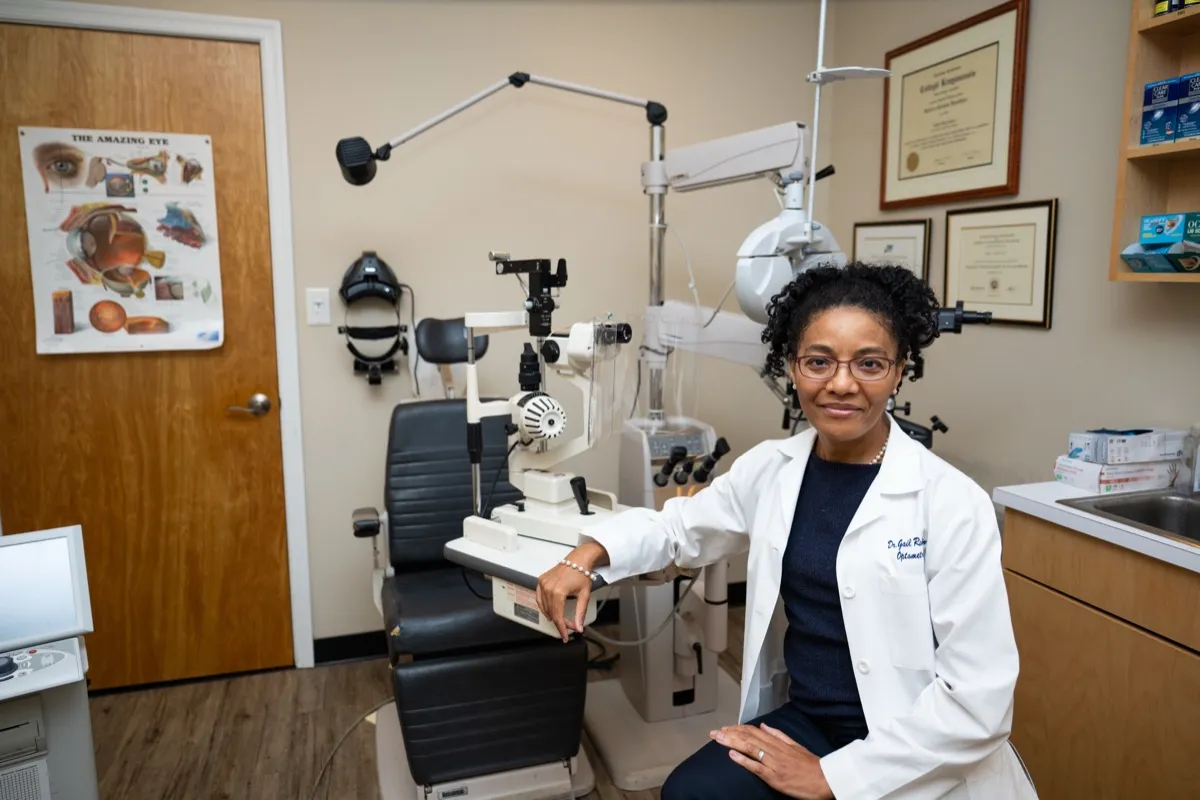
Dr. Robinson went well above and beyond for an out-of-town family in need of contact lenses for their daughter. If you’re looking for a fantastic optician with the most helpful staff in the DC area, you need look no further.

Chain-store fittings are quick by design: fifteen minutes, a handful of brands, a handoff. We do the harder work that turns a prescription into contacts you want to wear because they work and feel good.
Our optometrists fit contacts for Washington-area families every day, and that depth of experience means fewer trial-and-error cycles for you.
Every exam includes a full look at corneal curvature, tear film quality, and ocular surface health. The measurements a lens actually needs.
Your fitting, follow-ups, and urgent lens questions all go straight to an optometrist. Be confident you're getting the best advice.
We fit the full range of major brands (Acuvue, CooperVision, Bausch + Lomb, Alcon), plus certain specialty lenses when your eyes need them.
Daily disposables, monthlies, toric for astigmatism, multifocal for presbyopia, RGP for keratoconus, and myopia management for growing eyes. Here is what each is built for.
A fresh pair every morning, discarded each night. No cleaning, no case, lowest infection risk. The starting point we recommend for most first-time wearers and allergy sufferers.
One pair worn for thirty days with a nightly cleaning routine. Lower per-day cost than dailies, suitable for full-time wearers comfortable with a care regimen.
Weighted to stay oriented on an unevenly curved cornea (astigmatism) for sharp, stable vision instead of the smear a standard lens leaves. Available in daily, bi-weekly, and monthly.
Near, far, and intermediate in a single lens, much like progressives do for glasses, so most patients over 40 can leave the readers behind. Multifocal toric covers combined presbyopia and astigmatism.
Rigid lenses hold their shape on the eye, giving crisper vision than soft for high astigmatism and keratoconus (a cornea that bulges into a cone). Sharper sight in exchange for a longer adjustment period.
Daily disposables for children mature enough to follow care instructions, typically ages ten and up. We give younger patients extra training time to build confidence with insertion and removal.
Myopia management lenses are recommended when appropriate to slow or stop the progression of a child's nearsighted prescription.
A box of dailies for travel, swim training, or workouts, alongside everyday glasses. Many patients wear both, switching as the day demands.
A contact lens exam covers everything a comprehensive eye exam does, then adds the measurements a lens worn directly on your eye needs.
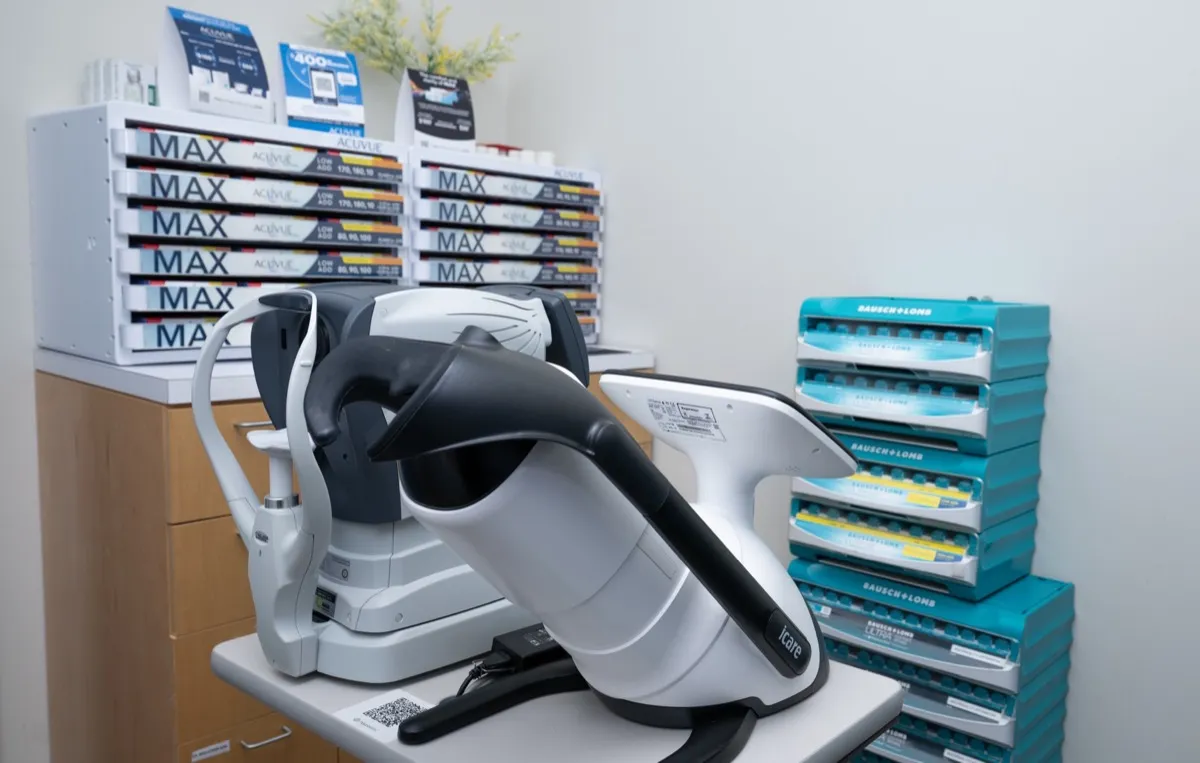
A comprehensive eye exam checks your vision and eye health and lands on your glasses prescription. A contact lens exam adds the measurements a lens that rides directly on your cornea actually needs.
Keratometry maps your cornea's curvature, when needed, to set the correct base curve and diameter. A tear film evaluation confirms your eyes stay moist enough for comfortable all-day wear. Slit lamp evaluation of the contact on your cornea determines if the lens is centered and moving well with your blink. Skip these steps, and you get a lens that blurs on every blink or dries out by lunch.
Karen had cycled through opticians and eye doctors for years carrying what she calls "a very difficult prescription," the kind that some practices quietly round off and hope you will not notice. At our Foxhall Square store in DC, Dr. Voorthuis took the opposite approach: she gave Karen "in-depth advice and options regarding my contact lenses," walking through the trade-offs rather than handing over the first box on the shelf.
The fit held. "Voorthuis has always gotten it right," Karen wrote, "over the many years I've been going there." She came back for the frames too: "excellent selection, and superb help in picking ones that suit you."
Karen M. · Foxhall Square, Washington DC
| What to weigh | Daily disposable | Two-week or monthly |
|---|---|---|
| Cleaning routine | None: new pair each morning | Nightly rub, rinse, and store |
| Infection risk | Lowest: sterile lens every day | Low when handled correctly |
| Dry eyes & allergies | Best: no day-to-day deposit buildup | Deposits can accumulate over the wear cycle |
| Travel & sport | Grab a strip, no case or solution | Carry the full care kit |
| Annual lens cost | Typically $500-$800 | Typically $200-$400 |
| Best for | Most wearers, allergy & dry-eye sufferers, part-time wear | Full-time wearers comfortable with a care routine |
For most patients we lead with daily disposables: the healthiest, lowest-maintenance option. We reach for two-week or monthly lenses when budget or full-time wear makes them the better fit. Your optometrist makes the call with you at the fitting, not from a price list. Prefer glasses most days? See our prescription lens options and our designer eyewear collection.
What happens when you come in, step by step. You leave with lenses dialed in for your eyes and your day.
Our optometrist examines the front surface of your eye under a slit lamp (the microscope we view your cornea through) and screens for dry eye and any condition that affects lens wear. This happens before any measurements.
Keratometry maps the curvature of your cornea to set the correct base curve and lens diameter. That measurement is the difference between a lens that sits comfortably and one that slides. A tear film check confirms your eyes make enough moisture for all-day wear.
Your contact lens prescription differs from your glasses prescription, because the lens sits right on the eye rather than an inch in front of it. We refine the power, then talk through screen time, sports, and commuting to match the lens type to your day, while also managing your expectations.
You wear a trial pair in-office for fifteen minutes while the optometrist evaluates fit, centration, and movement under the slit lamp. If the first pair is not ideal, we try alternatives until the fit is right.
For first-time wearers, our staff walks you through inserting, removing, and caring for your lenses until you feel confident in the office. A week or two later you return so the optometrist can confirm corneal health and comfort before your supply is ordered.
Voorthuis does not bill vision insurance panels, and we are direct about why. Those panels set short windows and steer toward a limited approved list. Stepping outside them is what lets our optometrists give you a thorough exam and recommend the lens that actually fits your eye - not the one a plan happens to cover.
Lens supply costs vary by modality and brand: daily disposables generally run $500 to $800 per year, monthlies $200 to $400, and specialty lenses are priced individually by design. Your optometrist walks through the options and pricing during your exam, so there are no surprises at checkout. For the bigger picture, see why we skip vision insurance in the first place.
We accept FSA and HSA for the exam, take all major credit cards, and provide a fully itemized invoice you can submit to your plan for out-of-network reimbursement.
I have been going for years to get my eyes checked routinely. I have astigmatism and need lenses to drive, and I now have great-quality contact lenses that I am very happy with.Christopher G. · Westbard Square
I forgot my contacts at home while on vacation and needed emergency care. Voorthuis helped me right away, which let me safely make the long drive home. Grateful for the compassionate care.Stacey L. · Foxhall Square
Dr. Figler was terrific - the best I have been to in the area. He is thorough, patient, and knowledgeable, and I can see so much better with my new contacts.Jayne G. · Old Town Alexandria
Comprehensive, unhurried exams with an on-site optometrist - the time your eyes actually need.
Progressive, single vision, computer, and specialty lenses - measured, selected, and verified by an experienced optician.
Soft, hard, multifocal, and toric contact lens fittings. Trial lenses, insertion training, and follow-up included.
Maui Jim, Oliver Peoples, Robert Marc, Brunello Cucinelli and more - in clear, polarized, photochromic, and prescription.
Doctor-led tear-film evaluation, meibomian gland assessment, prescription therapy, IPL, and RF treatments - built around a real diagnosis.
Eyeglass repair, free lifetime adjustments on Voorthuis frames, screw and nose pad replacement, and ultrasonic cleaning - usually while you wait.
Call your nearest Voorthuis to book a contact lens exam with an on-site optometrist.