What to expect at your eye exam
Every step, and what each one is actually checking.
A comprehensive eye exam is a medical evaluation, not a quick chart reading. Here is the walk-through, step by step: what each instrument checks, what your doctor is looking for, and why the depth at each step is the point.
1. Check-in and your health history
The first few minutes are a conversation. Your medical history, current medications (including over-the-counter ones), family eye history, and any symptoms you’ve noticed: blurry vision, headaches, dry or gritty eyes, trouble driving at night, words lifting off the page.
None of it is filler. The eye is connected to the rest of your health, and this is the context that tells the doctor where to look closely.
2. Pre-testing, the quick baseline
Before you see the doctor, a few painless baseline readings: an autorefractor makes a first estimate of your prescription, and we measure your intraocular pressure (the fluid pressure inside the eye). They take only a couple of minutes. That keeps your time with the doctor for judgment and the exam.
3. The doctor’s exam
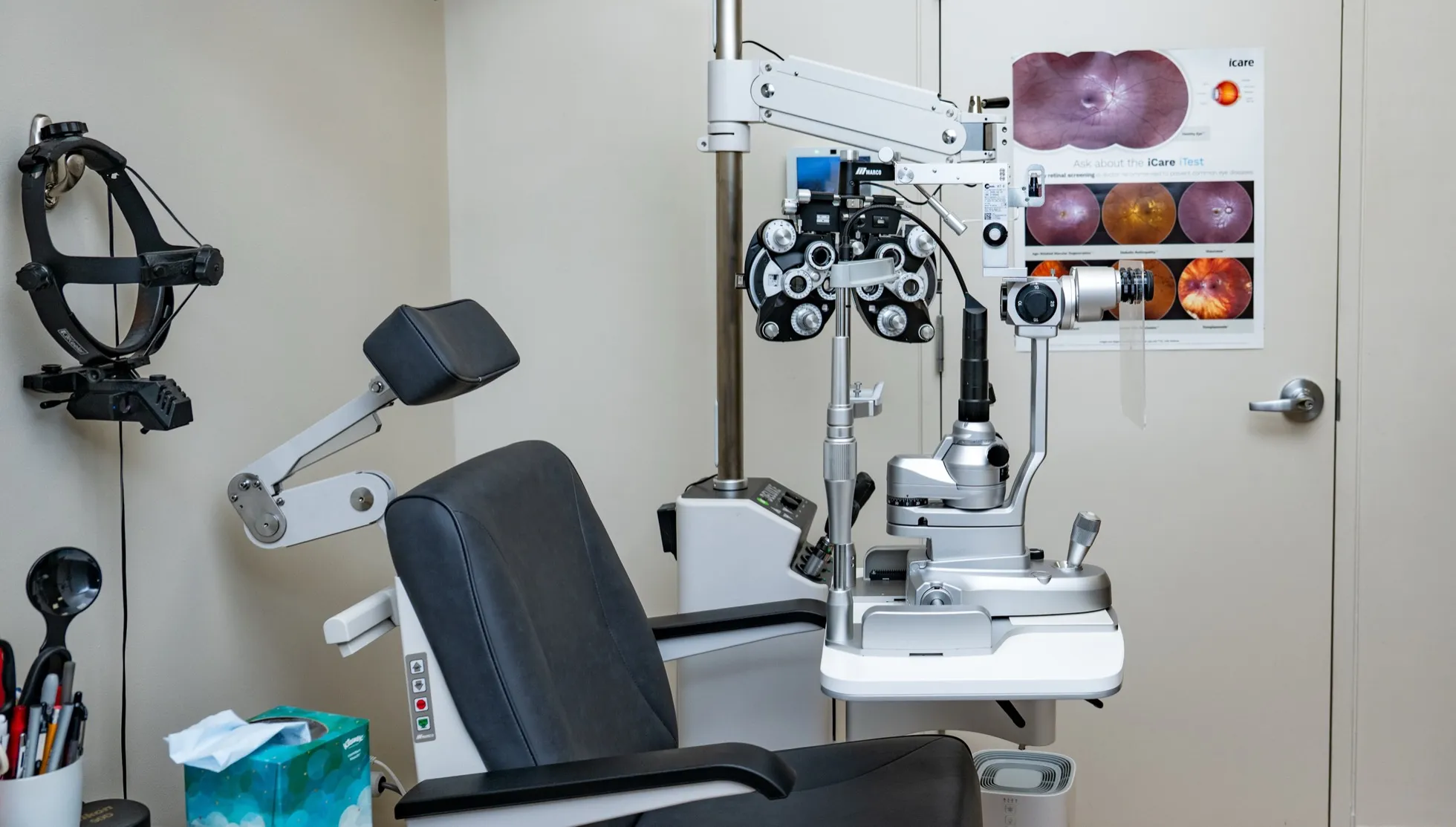
This is the heart of it, and an optometrist runs the full appointment from start to finish. Through the slit lamp (a microscope with a chin rest) your doctor examines the front of the eye: cornea, iris, lens. Then the retina and optic nerve at the back, with wide-field retinal imaging or dilation drops when a closer look is needed.
This is where cataracts get caught early, where macular degeneration first appears, and where dry eye is diagnosed. The retina is also the one place a doctor can see your blood vessels directly. So damage from diabetes or high blood pressure often shows up here first, sometimes before any other doctor has flagged it.
A dilated exam is the reliable way to see these changes. For anyone with diabetes, early detection prevents most diabetes-related vision loss. Glaucoma caught here, before symptoms show, is very treatable.
4. Refraction and the lifestyle consult
Now the part most people picture: the phoropter, the dial of lenses the doctor cycles through, asking “which is clearer, one or two?” until the prescription is exact.
There are no wrong answers; the question is how the doctor narrows in, and this hand-done refraction is more accurate than an autorefractor reading alone.
Then a conversation about how you actually use your eyes: hours at a screen, the commute, weekends outdoors. The lenses we recommend then fit your day rather than an average.
If you live with headaches or screen-driven eye strain, ask about Neurolens. It measures a small misalignment between the eyes that screen time worsens, then corrects it with a contoured prism built into your lenses.
5. Recommendations, and frames if you want them
You leave knowing your eye health and your options, explained in plain language.
If you want eyewear, an optician walks you through frames that suit your face and your prescription. If you don’t, there’s no pressure.
Patients regularly tell us they’d never had an eye doctor actually explain what they were seeing. The explanations are part of the exam.
Where the depth shows up
On paper, the protocol looks like any screening. The difference is how far each step goes: a longer history, more rounds of refraction, an eye-health check that reaches parts of the eye a quick exam skips, and the time to explain what it all means. That depth is the reason to choose a comprehensive exam at Voorthuis.
How to prepare
- Bring your current eyewear. Glasses and contacts both, so the doctor can compare against your existing prescription.
- List your medications. Including over-the-counter supplements; some affect vision and eye pressure.
- Note any symptoms. Even mild ones: headaches, eye strain, floaters, trouble reading or driving at night.
- Bring sunglasses. If we dilate your eyes, they stay sensitive to light for four to six hours. Sunglasses make the drive home comfortable.
- Plan for about an hour. That covers check-in and the exam itself, plus time to pick out frames afterward if you want to.
Not sure how often you’re due? See our guide to exam frequency by age.
Questions? Give us a call.
If anything in this article raised a question about your own eyes, give us a call. If we can't help over the phone, we can schedule you for an appointment.
Find your Voorthuis.
Call for an appointment.
Washington, DC 20016
Washington, DC 20036
Alexandria, VA 22314
Bethesda, MD 20814
Bethesda, MD 20817
Chevy Chase, MD 20815
Bethesda, MD 20816